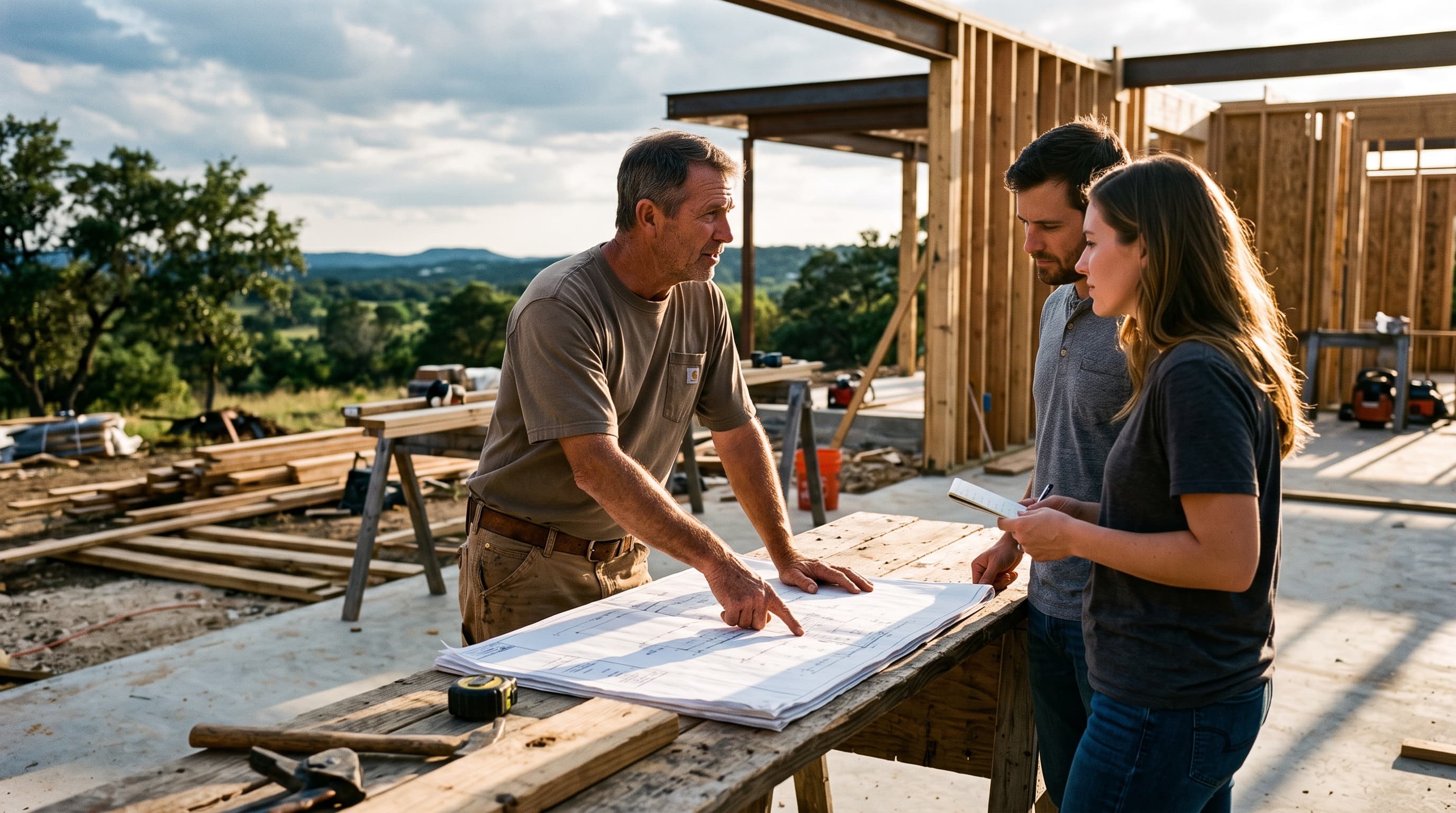
Most people start their home project with a floor plan they found online. A master builder starts by asking how you actually move through your day.
Building a custom home is the largest investment most families ever make. In the Texas Hill Country, that investment is tied to land that behaves unpredictably and weather that tests every joint in the frame. You are not just hiring someone to nail boards together. You are hiring a partner to manage the risk of your own investment.
The Difference Between a Contractor and a Custom Home Builder
There is a common misconception that any licensed contractor can be your home builder. A general contractor is often a coordinator: they hire subcontractors, track the schedule, and make sure the house gets finished. While that is necessary, it is not the same as custom building.
A true custom builder focuses on the "why" behind the build. If a plan calls for a certain window placement but the morning sun in Guadalupe County will bake out your living room, a contractor installs the window. A builder tells you why you should move it three feet to the left before the frame is even up.
The goal is not just to finish the project on time. The goal is to ensure that ten years from now, you are not dealing with foundation cracks or moisture trapped in your walls because someone followed a blueprint without considering the local environment. We look for the gaps in the plan where problems usually hide.
Managing Local Variables in Guadalupe and Comal Counties
Building in Seguin and New Braunfels requires a specific kind of local knowledge. You cannot apply a standard suburban building manual to the Hill Country. The soil here is notorious for shifting, and the humidity levels can ruin a finish if the house is closed up too early or vented poorly.
When you choose a home builder, ask how they handle site-specific challenges. I have seen too many homes where the septic system was placed in a spot that made future landscaping impossible, or where the well was drilled without considering the long term water table of the area.
Permitting in our local counties can also be a bottleneck. A builder who has spent twenty years working with local inspectors and county officials knows how to get your permits approved without unnecessary delays. They know the specific requirements for setbacks and drainage that are unique to this region. This knowledge does not show up on a blueprint, but it determines whether your project stays on schedule or sits idle for three weeks while you wait for a signature.
The Truth About Budgeting for Custom Work
The most stressful part of building a home is the fear of the "surprise" cost. You start with a number, and by the time the roof is on, that number has climbed by twenty percent. This usually happens because of vague estimates or a lack of transparency during the planning phase.
A premium build does not mean an unlimited budget. It means a precise one.
The key to avoiding cost creep is specificity. Instead of "high end flooring," we specify the exact grade of hardwood and the square footage. Instead of "quality cabinetry," we define the joinery and the material. When you know exactly what is being installed, the price becomes a fact rather than an estimate.
I believe in honest conversations about where to spend and where to save. There are places where spending extra money provides a lifetime of value, such as superior insulation or a reinforced foundation. Then there are aesthetic choices that look great in a catalog but add no real value to the home's longevity. A builder should guide you toward the former and warn you about the latter.
Why Local Trade Partnerships Matter
A home is only as good as the people who touch it. You can have the best blueprints in Texas, but if the plumber cuts corners or the framer ignores a level line, the house is flawed.
Many builders hire whoever is cheapest or whoever happens to be available. That is a gamble with your home. I rely on a tight circle of local tradespeople who have worked with me for years. These are people who take pride in their craft and understand that my name is on the final product.
When your builder has long term relationships with their subcontractors, there is a level of accountability that does not exist with temporary hires. If a mistake happens—and in custom building, something always does—a trusted partner fixes it immediately because they value the relationship. This creates a culture of quality where the goal is to do it right the first time.
What to Do Next
If you are planning a build in Seguin or New Braunfels, take these steps before signing any contracts:
- * Walk your land with a professional to identify natural drainage patterns and potential building sites.
- * List your non-negotiables for how you actually use your space, not just how you want it to look.
- * Ask potential builders for the names of three clients who built with them more than five years ago to see how the homes have held up.
- * Request a detailed breakdown of how they handle change orders and budget adjustments.
Building a home is a long process, but it should not be a stressful one. If you are looking for a builder who values the craft as much as the result, I would be happy to talk through your vision and tell you honestly what is possible on your land. Reach out to TKG Custom Homes and let's start a conversation about your project.


